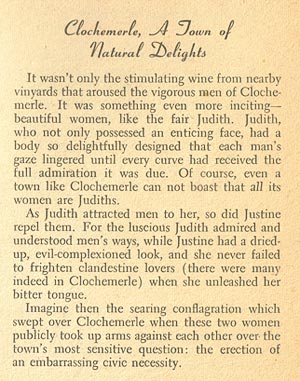
From the library's free cart of sale leftovers: a 1948 paperback—
Written in 1928 and first published in the U.S. nine years later, this is a comedy of life in an imaginary small town of the Beaujolais region. The plot summary—
A story marketed to "the male palate"—
The author opens with a page-long guide to the characters. The "Masterpiece of Nature" who drives the local men to desperation, and her opposite, the spiteful old maid, are among the large cast of local lovelies, merchants, functionaries, and notables. Some others are "THE CURÉ PONOSSE: A gentle priest who was filled with embarrassment by the confessions of the women of Clochemerle, a town in which the men were not inactive"; a pair of "eloquent" town gossips; "THE GIORDOT FAMILY: Of whom the less said, the better"; and so on (and on)...
Following this long (and rather tiring) list, the author adds that the action is joined by "a great assortment of excited artisans, tradesmen, winegrowers, soldiers, and politicians."
Dated as it may be, I would give this a try, if it weren't for the loose pages. ... Well, that and the moldy smell; nice art, but this is ready for re-tossing into a free pile.
The 1948 French movie version might be fun, at least as a period flick.
A fond tale about the amusing follies of the provincial cousins could have been a good source of post-war cheeriness.
Possibly cheering to the French, that is; the New York Times was offended by the movie's "feeble attempt to be witty at the cost of considerable bad taste." Said even as Bosley Crowther observed that "the picture is so extensively cut, for good and respectable reasons, that all you will now see on the screen is some rather crude French clowning in a virtually meaningless farce."
From presumably the same time is this Czech poster, with literal "bell-blackbird" rendering of the town's name.
Showing posts with label Book design. Show all posts
Friday, October 5, 2012
Thursday, September 22, 2011
Oriental Rugs, A. U. Dilley & Co.
Spotted at my regular haunt, the weekly library sale's 25¢ pamplet bin—a clothbound book with gilt cover design of a rug, complete with fringe.
Publication details inside were "1909, The Tudor Press, Boston"—so I was surprised this hadn't been caught and marked as a "collectible."
But even before spotting the date, I was amazed to see an end paper with the original owner's bookplate—

Yes, the name is this fellow's—

The book seems to have been a giveaway to customers of the "Oriental Rug Adviser"—

The text is quite informative, with photos and examples devoted to designs and weaving techniques of many different regions and ethnic groups.

It made sense that Stickley would acquire this for his library, as it seemed an authoritative guide to the subject. Despite the connection to a shop, this is no direct sales pitch; instead, the text is full of points on how to identify rug types and quality—including how to spot deceptive practices. The author writes in detail about methods of "aging" new carpets passed off as antiques, as well as other ways of selling poor quality merchandise to the unwary.
Searching the author's name, I learned that Arthur Urbane Dilley was not only a rug dealer, but also a noted authority on the subject. He later wrote full-fledged tomes; the 1909 book is eighty-one pages, and a complete scan is available here.
I was getting the picture of a gentleman-scholar type, and soon found that Dilley had founded an organization full of them: the Hajji Baba Club. Named for the hero of a nineteenth century novel, the club is a world all its own.
From the club site's history:
The club site's biography of "the first Hajji" describes Dilley's education at Harvard—where he lived in a residence room once occupied by Henry David Thoreau, a coincidence that fueled Dilley's ambition to become a great writer. Later drawn to studying antique Oriental rugs, Dilley developed a fascination that led to his career as rug dealer and scholar. Or make that, a scholar who was content to sell a rug as long as he could first educate the buyer to sufficiently appreciate it.
The bio also explains why my copy of the book has the original (Boston) address papered over, and a correction stamped in—

Dilley had set up shop in Boston, where in 1914 a devoted customer persuaded (and financed) him in moving the business to New York.
That patron also launched Dilley as a lecturer at museums, women's clubs, and other cultural venues. Before long—
Publication details inside were "1909, The Tudor Press, Boston"—so I was surprised this hadn't been caught and marked as a "collectible." But even before spotting the date, I was amazed to see an end paper with the original owner's bookplate—

Yes, the name is this fellow's—

The book seems to have been a giveaway to customers of the "Oriental Rug Adviser"—

The text is quite informative, with photos and examples devoted to designs and weaving techniques of many different regions and ethnic groups.

It made sense that Stickley would acquire this for his library, as it seemed an authoritative guide to the subject. Despite the connection to a shop, this is no direct sales pitch; instead, the text is full of points on how to identify rug types and quality—including how to spot deceptive practices. The author writes in detail about methods of "aging" new carpets passed off as antiques, as well as other ways of selling poor quality merchandise to the unwary.
Searching the author's name, I learned that Arthur Urbane Dilley was not only a rug dealer, but also a noted authority on the subject. He later wrote full-fledged tomes; the 1909 book is eighty-one pages, and a complete scan is available here.
I was getting the picture of a gentleman-scholar type, and soon found that Dilley had founded an organization full of them: the Hajji Baba Club. Named for the hero of a nineteenth century novel, the club is a world all its own.
From the club site's history:
...The club was formed in 1932, and early meetings were held in an apartment designed to recreate the setting from where the rugs came: Sheridan Square as Turkman yurt, and the home of Arthur Arwine, engineer. The other founding members were Roy Winton and Arthur Gale, both involved in aspects of the film industry, Anton Lau, another engineer, and Arthur Dilley, the scholar and dealer whose interest was his full-time job. Soon to join the rapidly expanding club were engineer Joseph McMullan, who amassed perhaps the most impressive collection of the group, and Maurice Dimand, curator at the Metropolitan Museum of Art.Those 1930s "Hajjis" and their Sheridan Square yurts may be rather quaint. But the club is still around and has done some nice museum exhibits; links to information and virtual tours here.
The club site's biography of "the first Hajji" describes Dilley's education at Harvard—where he lived in a residence room once occupied by Henry David Thoreau, a coincidence that fueled Dilley's ambition to become a great writer. Later drawn to studying antique Oriental rugs, Dilley developed a fascination that led to his career as rug dealer and scholar. Or make that, a scholar who was content to sell a rug as long as he could first educate the buyer to sufficiently appreciate it.
The bio also explains why my copy of the book has the original (Boston) address papered over, and a correction stamped in—

Dilley had set up shop in Boston, where in 1914 a devoted customer persuaded (and financed) him in moving the business to New York.
That patron also launched Dilley as a lecturer at museums, women's clubs, and other cultural venues. Before long—
Having firmly established himself in New York and having written dozens of lectures on a whole range of carpet-related topics, Dilley began to consider a major work on the subject. During the 1920s, rugs were a hot topic and, given the commercial success that Charles Scribner’s Sons had enjoyed with [John Kimberly] Mumford's Oriental Rugs – an immediate triumph in 1900 and by the 1920s in its fourth printing – Dilley had good reason to believe he could sell them the idea of offering another book on the same subject. He signed a contract with the publisher while both the United States economy and interest in rugs were dashing along at top speed, but unfortunately the Great Depression arrived before his book appeared, which meant that it, unlike Mumford's work, tended to sit on bookstore shelves.
But poor sales – only a thousand copies during its first two years in print – failed to dampen Dilley’s enthusiasm for his work. He thought of it as a literary achievement, not as a commercial commodity, and when, a few years later, he discovered a Houghton Mifflin textbook that included an excerpt from his book as a model of well-executed prose alongside examples from the likes of Charles Dickens, William Thackeray and Charles Lamb, Dilley considered his efforts validated, his book a triumph, the finest feather in his cap, one he would never exchange for a place on a list of best-sellers.
Saturday, September 25, 2010
"One of the fairest monuments that America has raised"
Part of title page; published by New York Public Library, 1961.This book commemorates the fiftieth anniversary of the Library's move to its Fifth Avenue location.
From the credits:
William K. Zinsser is a fourth-generation New Yorker who often writes about his home town. A former critic and editorial writer of the New York Herald Tribune, he is the author of two books and many magazine articles.That was a name I remembered from family copies of Life.
From my more recent reading, I recalled a jazz biographer's reference to a book by Zinsser, Mitchell & Ruff: An American Profile in Jazz. Its subjects are pianist Dwike Mitchell and bassist-French horn player Willie Ruff, and Zinsser seemed to be a writer who really got around.
Well, I see from his site: he is still around; Zinsser studied piano with Mitchell and in the 1990s did some performing in clubs.
That was only a small break from writing. Among other work during his long career, Zinsser wrote On Writing Well, "the classic guide to writing nonfiction," first published in 1976 and still in print. In 2005 he published Writing About Your Life: A Journey into the Past.
But getting back to 1961: the illustrator's name was not one I knew, although his style did look familiar—
Tom Funk, whose grandfather co-founded the New York publishing firm of Funk & Wagnalls, has been a free lance illustrator in the city since 1937. His fondness for its vistas is well known to readers of, appropriately, The New Yorker.

These are spot illustrations in classic New Yorker style. To get any decent detail I had to scan them as grayscale, but they actually are printed in a rich black, for a woodcut effect.
Zinsser opens with an anecdote from early in World War II, when the Library needed to consider whether some of its holdings should be removed for safekeeping.
When the curators met to discuss the prospect,
Each... spoke up for the items he thought most valuable: the Gutenberg Bible and the five First Folios of Shakespeare, the handwritten copy of George Washington's Farewell Address and Jefferson's early draft of the Declaration of Independence... and the illuminated copy of Ptolemy's Geography. The longer they talked, the longer the list stretched, for among the 7 million volumes are some of the rarest books and manuscripts in the heritage of mankind."Save the pamphlets" — now that's a director after my own heart!
... Harry M. Lyndenberg, director of the Library, listened gravely and finally said, "But first I think we should evacuate all the pamphlets."
Zinsser continues,
He meant that Gutenberg Bibles and Farewell addresses do at least exist in other copies, but that the pamphlets are unique. In thousands of cases the Library's edition is the only one that survives. The same thing is true of the countless old periodicals, broadsides, playbills, scrapbooks, popular songs and other fugitive documents that the Library — and nobody else — has bothered to keep. They are the routine archives of life. Trivial yesterday, they are priceless research tools today.Zinsser's text is accompanied by Funk's renderings of various building details, inside and out...
It is this passion for continuity, for collecting everything and discarding nothing that has made the New York Public Library a supreme reference source, one that extends backward in time to the Babylonian clay table and outward in space to every corner of the globe and many globes beyond...


Along with those views are illustrations representing the varied collections to be found in the Library's "eighty miles of shelves."

Zinsser describes those extraordinary collections, and the experts who staff them.
I don't work in the library world, and wouldn't normally recognize its notables. But here I actually recognized two names—from this biography of Joseph Cornell.
Like many New York area artists, Cornell was a frequent visitor to the Library. Children's librarian Maria Cimino met him in 1945, when he first did research in her collection. After her 1950 invitation to collaborate on a children's presentation, Cornell loaned some of his boxes. Enthusiastic about his first exhibit for children, he would participate in others in the future.
Romana Javitz was also a friend of Cornell's, as she was of other artists who used the Picture Collection. I first read of her in the same Cornell biography, but have since come across her name in other books about the New York art scene—of the 1930s and beyond.NYPL's site has this interesting article about the Picture Collection, and Ms. Javitz's role in expanding it into the important archive it became.
She originally studied art, then headed the Picture Collection from 1929 to her retirement in 1968. Among her accomplishments at the Library, she encouraged Arturo Schomburg in developing archives that became the Schomburg Center for Research in Black Culture.
With many friends and contacts among artists, Ms. Javitz became very active in New Deal arts projects. She was a driving force behind creating the Index of American Design, as well as being involved with Farm Security Administration photography and its preservation.
Zinsser ends his 1961 tour of the collections with this vision, worth quoting at length—
The quality that makes The New York Public Library great is one that runs deeper than men and books. It is the quality of freedom. This is a building that takes no sides because it presents all sides. It grants its visitors the dignity of free access to information. It does not hide the ugly or censor the injurious. These guarantees are woven through every division, and often they take extraordinary form. The Jewish Division owns the biggest known mass of anti-Semitic material; the Picture Collection has hundreds of racist cartoons; the Current Periodicals Room subscribes to subversive magazines.
At first glance such a policy might seem at least unsavory, at most perilous to the very freedoms that it is trying to protect. Rare is the library, in fact, that does not defer in these sensitive areas to the government, the institution or the trustees that control it. The New York Public Library makes no such surrenders. It operates on the belief that free men will find the truth, however devious the route by which they approach it, or at least that they should have the fullest opportunity to try. Enacting this belief every day of the year for fifty years, it is an ornament to democracy, one of the fairest monuments that America has raised.
Saturday, January 23, 2010
A Book Judged By Its Cover
I don't read Czech, but the embossed art nouveau front cover of this 1902 book grabbed my attention. The back cover has this seal with the publisher's name

An author bust on a title page
does tend to suggest that the contents are considered classic.Through the magic of the Internet, I've learned that Svatopluk Čech (1846-1908) was a journalist and poet who promoted national and Slavic identity. The Czechs, of course, were still ruled by Austro-Hungary during his lifetime, which was also a period of burgeoning nationalism throughout Europe.
This volume is Čtyři cykly básní (Four poetry cycles), a collection of works Čech wrote in the 1880s. Titles (according to Google Translate) are: Ve stínu lípy (In the Shade of Linden Trees); Jitřní písně (Morning Song); Nové písně (New Song); and Z potulek (unidentfied).
I haven't tried looking for translations of Mr. Cech's verse, so have no idea how it reads today. With all the political and cultural change since 1902, the Czech writers I've been drawn to read in English were writing much later, about a very different world.
But Czech decorative art of the early 20th century was a wonderful thing, as a small sample here shows.
And this unexpected book find is a link to that era.
Subscribe to:
Posts (Atom)