Showing posts with label Cookery. Show all posts

Monday, September 3, 2018

Thrift Shop Day

Swedish cookie press set—
Recipe booklet—

Household essential—

Convincing!


Wowee...
Leather apron with painted fraternity motifs. I wasn't aware of the Masonic influence this suggests, but it makes sense for a male group with secret rituals.

Another view—

No clue what's represented by the mask, or by what looks like a stone planter with shrubbery. The only easily interpreted symbol is hearts chained to the University of Michigan ...

Couldn't come up with any Greek speakers to ask, so I used this to try typing out the motto. Translator gave me the first and last word as Αδελφοι - brothers, and Κοινη - common
It fits a joined-in-brotherhood concept. The middle word was harder to discern, though, and the result for my guess was less exalted—
Σρεδτια - walnuts
I like it! But really, this must be some word expressing a highfalutin concept. Unless walnuts is for a version of strong oaks growing from acorns? Or this was a forestry students' fraternity? Maybe it's all something to do with shrubbery.

Apron supplied by—
A company ad (Banta's Greek Exchange: Published in the Interest of the College Fraternity World, 1914)

Tuesday, August 21, 2018

W.I.N.O.S.

Today at the library free book cart.

Saturday, November 12, 2016

Red Meat

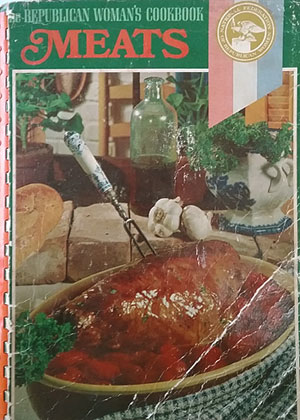
The Republican Woman's Cookbook: Meats
National Federation of Republican Women, Montgomery, Alabama, 1969.
I don't imagine Maine was voting Democratic, so I'll assume it was on principle that the GOP  promoted apartheid South Africa's lobster industry.

Another sponsor: the Florida Citrus Commission. Though it wasn't until the late '70s that anti-gay rights agitation by a newly political religious right would become associated with Florida orange juice—or that a boycott would then target the product.

Interesting that the group was based in Montgomery, even before the full-blown Southern Strategy. At the time, racists could still run as Democrats and be elected to offices across the South. During most of the 1960s, for instance, George (and later, Lurleen) Wallace held the Alabama governorship as Democrats. Wallace was re-elected in 1972, then ran in Democratic presidential primaries.

If Nixon's plan for the South was not yet in evidence, the little woman puts in an appearance (cloth coat not in evidence, either)...
Also (from the Introduction): "No matter how involved Republican women become in the local and national scene, we are primarily interested in our homes and families." So it was then as it is now— at least for purposes of public consumption and culture war branding.

Some recipes set out to maintain the brand—
There are proletarian meals, and it's even possible to believe some of these people weren't faking ("Governor Romney's Favorite Bean Soup").

The senator wasted no time or fuss in the kitchen.
Hers was one of only a handful of attributions under a woman's own name. Some are names they just don't make anymore...
Fern R. Uglick, Corr. Sec.
16th and 17th Wards WRC 7
Toldedo, Ohio

Florence P. Toothaker, Sec.-Treasurer
Platte Valley RWC
Encampment, Wyoming

Shirley B. Hassdenteufel, Prof. Chm.
New Windsor WRC
New Windsor, New York
Male officeholders and cabinet officers offered recipes under their own names, but submissions from the womenfolk all stress their being wives of ("Black Walnut Stew," courtesy, "Mrs. Barry Goldwater, Wife of Senator From Arizona").

Now there's a name inspiring genuine terror that anti-Commie belligerence would get us all blown up.

... Yet Goldwater's later criticism of fundamentalist crazies—and the fact that his wife helped found Planned Parenthood—would get him drummed out of their party today.

Srom Thurmond shows up here, but so do Edward Brooke (Mrs.) and two Rockefellers (Mrs. Nelson and Mrs. Winthrop). Once upon a time, there were actual moderates in their party. And compared to the ones about to take over DC, the racist wingnuts of yesteryear's GOP may come to seem like pikers.

To be fair, the oddest recipes are no odder than what's found in other fund-raising cookbooks of the period. So, we see here "exotic" jello molds, fried chicken coated in crushed Ritz crackers, and "chow mein" made with tomato soup.

We also have—
Those two are "Meat Combination Recipes," not part of this section—
GOP housewives of the past: veritable cosmopolitans.

Saturday, May 16, 2015

Women's Works

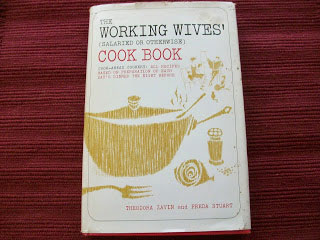
The Working Wives' (Salaried Or Otherwise) Cook Book  
Theodora Zavin and Freda Stuart, 1963

No illustrations; just a jacket cover missing from this copy. (Image from a source I've lost)...

After a dedication listing names of both authors' husbands and children ("the world's most charming testing laboratory"), the text briskly gets to the point—
We have never known a man who waxed nostalgic over his mother's ability to mop floors or one who boasted that his wife could wash socks better than anyone on the block. But oh, the lovely pedestal that awaits the woman who cooks!
The authors acknowledge that there were already lots of shortcut cooking books available, but say they had found those books inadequate. Inadequate for a number of reasons; "Most important"—
... the really good "quick" cook books enable the cook to get dinner on the table within one to one-and-a-half hours after arrival home, provided that she dashes madly from the front door to the kitchen without removing her hat and juggles pots, chops onions, and generally goes frantic for an hour or so before dinner is ready. This procedure has a few obvious drawbacks.

While we are second to none in our admiration of the working wife, it must be admitted that she lacks some of the fine lasting qualities of an electronic computer. After a long day's work, no respectable IBM machine feels a desire to take off its shoes or have a drink. Woman, at 5:45 thy name is frailty.

This is a tough hour of the day in which to scramble. It is just at this time that children (and husbands, too!) want and deserve attention. It's hard to listen to the story of today's baseball game, prescribe for a wounded doll, and measure out ingredients simultaneously. What's the alternative—other than hiring a cook or spending precious weekend time cooking and freezing for the week ahead? The solution lies in preparing most of each day's diner the night before. And that's the essence of our system.

We know several things about the working wife. She is not an habitué of the Stork Club. She spends many, if not most, weekday evenings at home. She gets her second wind after the children are in bed, and that's the magic time to do the few things in the kitchen that will enable her to spend most of her post-homecoming hour with a chuild on her lap or a drink in her hand (both, if she's a talented type), with only an occasional foray into the kitchen to pop things into the oven or onto the dinner table.

While this book was planned primarily by and for working wives, we think it has great value for what are (laughingly, we hope!) known as "nonworking" wives—those "ladies of leisure" with three preschool children, a once-a-week maid, eighteen committees, and questions like "Honey, do you mind if I bring Bob Kirk of our Atlanta office home for dinner one night this week?" The cook-ahead dinner makes for lovely entertaining because Frazzled Hostess is not served as the first course.
The basic system: on Friday evening check the next week's calendar, choose dinner menus suitable for the time available each night, draw up a shopping list, and buy the ingredients Saturday.

That's from the Introduction, followed by—
THE WHEREWITHAL (OR, APPLIANCES YOU COULD LIVE WITHOUT, BUT WHY?)

To say that we are fans of the time-saving, labor-saving, woman-saving electric appliance would no more reflect the depth of our passion than to say that Rome had a "crush" on Juliet. We have been sisters-in-law for several years, and one of our great contributions to each other's welfare has been that the gadget not discovered by one of us has been unearthed by the other....

Top of the list is a dishwasher. After a couple of pages disposing of arguments against having one, the authors note of expecting husbands to wash dishes—
...the working wife must, of necessity, always be aware that the mere fact of her working may to some degree impinge on her husband's feeling of masculinity. She must be doubly cautious about not heaping "women's work" on him. We have the impression that most working wives are so sensitive to this that, whoever that beleaguered, emasculated, domesticated husband may be whom the magazines are always decrying, he is not the husband of the working wife.
Here, the authors cite research from a doctoral dissertation—
... In her study of 44 families with working mothers, Dr. Greenwald found that in only 17 of 44 households did the husband regularly take any part in doing the dinner dishes and in 14 of these 17 families, the wife was doing dishes right along with him.
The study found that amount of limited dish-washing was by far the highest rate of husbands' participation in household chores.

This cook book was published in 1963, the same year as this. Something was in the air...

Zavin and Stuart took a practical view of Woman's Work. They had found a system that gave them control, and they felt they could benefit other women by encouraging them to adopt it.

The recipes tend toward variations on a theme of meat cooked in a base of canned tomato (stewed and/or sauce). There are a few simplified items based on ethnic cooking ("Kusa Mihshi: Stuffed Squash in the Lebanese Manner"; "East Meets East: Syrian Meat Balls with Indian Curry Sauce"), and some recipes in the period style of women's magazine food writing ("Tropikabobs": cooked ham with canned mandarin oranges and pineapple chunks).

As in the introductory sections of the book, the text preceding some of the recipes is entertaining.

Instructions for making "Mrs. Albini's Baked Lasagna" opens—
Every time our friends, Emilia and Thayer Taylor, have a baby, Emilia's mother... comes down from Gloversville for a couple of weeks to help out. At some time before she goes home she cooks what she deprecatingly calls "just an old-fashioned Italian dinner" for a few of the Taylors' lucky friends. As a result, these may be the only babies in the world whose birth announcements make the recipients lick their chops in happy anticipation.
And introducing a group of molded salad recipes—
...if the traditional method of unmolding a gelatin salad (dipping the mold in warm water and then running a knife around the edge) doesn't leave you too happy, here's a very safe method you can try. It was suggested by our friend Marion Brown, whose cooking terminology seems to have taken on a slightly medical air, transmitted, no doubt, from her doctor-husband's office. (Marion is the only woman we know who makes a bouquet garni using medical gauze).
Followed by steps for Marion's method of loosening a gelatin mold with a hot towel ("She describes this as 'putting hot compresses on the mold.'")

The sister-in-law authors were a highly simpatico pair. With perhaps one exception: the ingredient list for Chicken Soup with Matzo Balls calls for
1 to 2 teaspoons of salt (sorry, the two of us don't agree on the amount; you'll have to make up your own mind.)
I've also lost the source of this image, but here's the back cover—

According to the author bios—
FREDA STUART is that rarity, a New Yorker who has always lived in the city where she was born. She graduated from the City College of New York. Later she was associate editor of a trade magazine. At present, Mrs. Stuart is an (unsalaried) Working Wife and cooks for her husband, one daughter and friends.
She may have remained a non-salaried wife, as I don't find reference to a further career or published work.

Theodora Zavin, on the other hand, had a very public career at the time she collaborated on this book. A lawyer who had co-written legal books aimed at laypeople, she was in 1963 vice president of Broadcast Music, Inc.

From a 2004 BMI obituary, after Zavin's death at 82—
BMI and the BMI Foundation mourn the passing of Theodora Zavin, one of the music industry's most respected copyright attorneys, who served as a senior executive at BMI....

Zavin served at BMI for 49 years, joining the company in 1952 as head of its legal department, rising to Senior Vice President and Special Counsel at her retirement in 2001. She founded the BMI Foundation, Inc. in 1985, serving as its President until her retirement and President Emeritus until her death.

Zavin was legendary in the music copyright community for her fierce defense of the rights of musical composers both here and abroad. Over her long career she also developed close personal relationships with many seminal composers including John Williams, Lionel Newman, John Lennon and Yoko Ono, John Kander and Fred Ebb, Jerry Bock and Sheldon Harnick, Alan Menken and Maury Yeston.

A graduate of Hunter College, where she was a member of Phi Beta Kappa, and The Columbia School of Law, where she was Notes and Comments Editor of the Law Review, she served as President of the Copyright Society of the U.S.A., was a member of the United States Copyright Office Advisory Committee, and the Copyright Committee of the Bar Association of the City of New York. Internationally, she represented American interests as a leader of the Legal and Legislative Committee of the International Confederation of Societies of Authors and Composers (CISAC).

Zavin combined her legal talents with a deft personal touch with songwriters, composers and music publishers at BMI. In 1965, she was appointed Vice President, Performing Rights, leading the company for more than 20 years during one of its most dramatic periods of growth, personally signing representation agreements with such songwriter/artists as Paul Simon and Art Garfunkel, Billy Joel, Carole King, Mort Shuman and Doc Pomus, and Neil Sedaka, such legendary Brill Building music publishers as Don Kirschner and Al Nevins, and international figures such as Beatles' publisher Dick James.

Zavin wrote prolifically for leading law journals on copyright and was co-author of several books aimed at demystifying and making the law accessible to the layman, including Rights and Writers and Your Marriage and the Law. One of the music industry's best-known hostesses, Zavin also authored two well-received cookbooks, The Working Wives Cookbook with Fredda [sic] Stuart, and The Everybody Bring a Dish Cookbook.

Sunday, June 24, 2012

Going Like Hottokēki

Gather round the takoyaki grill... J's find at the annual rummage sale held by a Japanese ex-pats' club.
This says takoyaki, followed by small print: hottokēki (hot cake), then Chinese characters I read as "maker." Characters should be grill + both (or, together) + use. So, a takoyaki maker for "dual use"? For either grilling or baking? Or to make some alternative octopus-shaped dumplings?

In any case, here's the business end, for pouring in batter.

Other side...
"APOLLO"
Just to be sure there's no mistaking the product, the head of the family kicks things off. Watch the expert, as he digs happily into a steaming batch of grilled octopus dumplings!

Saturday, May 5, 2012

Marketing? ¡Sí!

It was in the 1980s that U.S. commercializing of Cinco de Mayo began.

Here's a use of "colorful" Hispanic culture that's a bit earlier (as well as being California- and industry-specific)—

This copy is "Rev 4-78"; put out by—

Where the fruit is grown (click for full size)—

Detail—

"Avocado Bravo," the copy writer informs us, is "Spain's Legacy to California Cuisine"—
As shown on our cover, it is the spirit of a bold and dashing cooking style that we would like to capture for you in this book... with the full color and flavor of the Spanish West.

The very word California carries the smack and crackle of adventure...a colorful procession of historical personages [...]

From the highborn Castilian officers sent from Spain to protect the missions, the original Californians are descended. These young dons sent back to Castile for their womenfolk, and the mistress of each hacienda taught her Indian servants to cook in the classic Spanish style.
Yes, this has original Californians being served by Indians, who would seem to have materialized from thin air.

To continue that paragraph—
What evolved as a formalized cuisine of the Spanish West was a spirited blend of Spanish, Mexican and Indian... with a little Gringo thrown in, as many a proud, but impoverished hijodalgo [sic] married off a dowry-less daughter to a blue-eyed, go-getting Yankee. The Spaniards brought their delicate egg dishes, their spitted meats and barbacoa. The Indians contributed the secrets of corn cookery. The Mexicans came north with peppery salsas fired with spices and cooked with limes. And chocolate, of course. And avocados. Avocados crushed for guacamole...halved to stuff with tomatoes, coriander and green chili—or to eat net with a squeeze of lime and a little tequila...whole, just to savor with a lick of salt.

California's own uninhibited cuisine offers a hundred ways to serve avocados [... ] These recipes reflect the open-handed hospitality of the West, combining ingredients in a free-wheeling western manner to achieve splendid effects of color, texture and flavor and...overall...a certain rough elegance that is uniquely Californian!
This is followed by a history of the fruit's cultivation; useful tips—
"Some pleasant things about avocados" touts the versatility and nutritional value. Not only that, but you can grow a tree; the next page offers full details.

Some of the recipe illustrations—


And, yes—


This gets so psychedelic that it must be said: Avocado Seed Soup!

Sunday, February 5, 2012

Sugar Frosting

The National Sugar Refining Co. of N.J., 1932


Early in the twentieth century this brand turned the name of a nipping-at-the-nose winter demon into a cheerful kewpie, personifying the snowy whiteness of its product.

When this booklet's inner pages are opened, a cutout at the fold displays a Jack Frost image printed on the inside covers.
As is so often true of old giveaways, the print quality is impressive. Like the front cover border, this background is embossed metallic silver.

The "really unusual recipes" pitch is interesting. From the inside front cover—
They are something different. Each one has been tested by people who love good things to eat and we have included in this booklet only those recipes where the verdict rendered was, "Mmmm, isn't that good!"

The secret of them all is that they are simple recipes and if followed exactly, can be made by the most inexperienced cook. Unusual and perfectly delicious results are obtained, through the choice of different kinds of Jack Frost Sugars. These recipes illustrate perfectly how the right kind of Jack Frost Sugar in the right place makes eating an exciting adventure instead of a routine activity.
Perhaps it was a subliminal approach, for a sugar company to persuade home cooks that these recipes were especially refined.

And it may well have reflected the early twentieth century popularity of tea rooms. Luring customers with creative décor and atmosphere, tea rooms seem to have led the way to eating place as special destination, according to Jan Whitaker's book. Menus consisted of "dainty" specialties, billed as intriguingly unique—even if most establishments served pretty similar items.

Of the eight pages of recipes, here's another sample—
The brand still exists, although it's part of a newer conglomerate. Instead of the old, androgenous kewpie, the logo character now is a blandly generic elf.

Saturday, February 26, 2011

Cooking In a Bedsitter

A 1977 paperback: "First published as Kitchen in the Corner, 1961"—
Even though the cover is the only illustration, this book is a treat (if for reasons other than my wanting to use the recipes).

The author is of the school of English writing which treats all subjects with unrelenting cheer.

Never mind that you live in a single room: you, dear reader,
can always muddle through
Cooking a decent meal in a bedsitter is not just a matter of something that can be cooked over a single gas ring. It is a problem of finding somewhere to put down the fork you take the lid off the saucepan, and then finding here else to put the lid. It is finding a place to keep the butter where it will not get mixed up with your razor or hairpins. It is having your hands covered with flour, a pot boiling over on to your landlady's carpet, and no water to mop up any of it nearer than the bathroom at the other end of the landing. It is cooking at floor level, in a hurry, with nowhere to put the salad but the washing-up bowl , which in any case is full of socks.

However, with imagination, common sense and a great of newspaper, all this can be surmounted...
The first hurdle to consider:
... it is a sad fact that the better the room itself and the house in which it is found, the worse the cooking problem tends to be. In a large squalid rooming house, where the landlord calls only to collect the rent and where the cleaning, if any, is done by an indifferent slut with no standards to maintain, adventurous cooking is perfectly possible. If you find the sink filled with someone else's filthy crocks you can heave them out on to the floor without fear of a come-back. If you fill the whole house with the smell burning onions you will be cursed but not evicted; and nothing will look much worse whatever you spill on it.

But in a respectable house you have much more to worry about. Often you are not really supposed to be cooking at all (it is a common fallacy among the better class of landladies that one can exist entirely on tea, biscuits, and good books, without the need for food, beer, the wireless, or the companionship of the opposite sex). At the slightest crash your landlady will come tittupping out of her sitting-room to worry about the effect you are having on her nice furniture. If you want to peel onions under running water, you will probably have to peel them in your bath; and there will be nobody from whom you can borrow salt or a corkscrew in moments of emergency.
Where there is a will, our author believes, there are ways and means—one only need recognize certain limitations:
The principles of English cooking demand that first-class food should be cooked as simply as possible, and that a number of different foods should be cooked separately and served together. This is impossible on a gas ring. Indeed, bedsitter people have far more natural kinship with nomads brewing up in the desert over a small fire of camel dung, or impoverished Italian peasants eking out three shrimps and a lump of cheese with half a cartload of spaghetti.

The first thing a bedsitter cook must do is abandon the idea of 'meat and two veg', in favour of the idea of a simmering cauldron... And that brings us, inevitably to the casserole.
Here is how Ms. Whitehorn introduces readers to one-pot cooking:
OUT OF THE FRYING PAN AND INTO THE CASSEROLE

A French politician representing a somewhat backward district in Africa was some time ago found to have been eaten by his constituents. The journalist who discovered this used the phrase: 'Je crois qu'il a passé par la casserole' (I think he ended up in a casserole). Clearly the Africans knew what they were about. For making a delicious meal out of tough and intractable material, the casserole has no rival; and though, traditionally, most casseroles are oven dishes, all but the ones needing a crusty top can very well be done on a gas ring over an asbestos mat.
Not to worry: he was, after all, a Frenchman...

Before getting down to recipes, the author offers pages full of helpful tips, such as:
The coldest place in a bedsitter is very often under the bed. By all means keep food there, in a suitable box; though you had better find a way of reminding yourself of its presence before it reminds you.
Some advice is quite detailed—
BREADCRUMBS: Breadcrumbs are a bore in a bedsitter, but sometimes one must have them. There are four ways of getting them:
(1) Buy them. Some bought breadcrumbs are an alarming shade of orange and suitable only for fish; others are quieter in tone and will do for Wiener Schnitzel, fried chicken, etc. Bought breadcrumbs are not very suitable for the kind of pudding where you will eat them as they are, without further cooking.
(2) Dry slices of bread in front of the fire until they are hard; wrap up in newspaper, and first bang then roll the parcel until it is a parcel of crumbs.
(3) If you have a grater, you can grate a chunk of bread to make soft crumbs; but these are no good for frying.
(4) Get some housewife who hates to waste crusts to give you some of her crumbs.
The recipes here are more ambitious than heating canned soup, but still are campfire cooking; really, all that can be done in this setup. And as former chef and London resident J. remarked, not only are the dishes pathetic, but many are the kind of thing a corner shop would sell, ready-made.

The author does, however, offer wisdom beyond simplified recipes and single-pot cooking.

Ms. Whitehorn's guidance about coping with one-room life includes preparing and cooking for categories of visitors, from
Your parents, or your parents' spies — who are there to reassure themselves that you are eating adequately, get to bed early, know no vicious young men, and breathe plenty of clean fresh air.
...to, "Delicious little parties à deux."

That last includes separate sections, on "COOKING FOR A MAN" vs."COOKING FOR A GIRL", and:
ASKING HIM UP
...If you are not sure of the state of the room, don't ask him in. Many is the young man I have horrified by saying, 'Oh, do come in, I'll have it all cleared up in a minute,' picking the dirty clothes out of the fender as I spoke...

Do not, whatever you do, tell him the truth and say: 'You can't come up, because I haven't made the bed.'

ASKING HER UP
...If you have a set of rough and ready house rules designed to protect the amorous from casual interruptions, DON'T put these precautions into effect unless you really mean business. Nothing causes the timid fawn to shy away faster than the feeling that the rest of the house knows what she is in for (especially if she hopes she isn't). A towel hung over the outside door handle may lose you game, set, and match.
Ms. Whitehorn offers an Epilogue, where she suggests there may be one person in Britain
... who has wholly solved the problem of eating well in a bedsitter. When I went to visit him, a compound smell of celery, garlic, and freshly ground coffee - the essential smell of a French kitchen - met me faintly as I climbed the stairs. There was a sound of steak-bashing from within, and when I knocked on the outside of his door, a bag of vegetables fell heavily to the ground on the inside.
That last touch seems a bit much, and other details about "Marcus" and his room are laid on thickly:
... On every wall there were hooks from which hung knives and saucepans, and a string of onions, and another of garlic, a salad-shaker and a grater, and two kinds of egg whisk, and a bunch of bay leaves. The only picture was a Victorian still life in oils, showing a brace of freshly killed pheasant with some vegetables. There was a beer barrel in one corner, with an old slipper under the to catch the drips; and in another some curd cheese draining into a small shaving bowl through a sock. The open wardrobe door revealed, beneath the somewhat agricuItural jackets and trousers, a box of earth in which some mushrooms were growing.
The backstory is that Marcus had been working as a chemist when he invented and patented just the thing for bedsitter occupants: a refrigerator that uses chemicals and needs no power source—
... a model of this now stood in the shadows near his wardrobe. The invention had sold, though not spectacularly; Marcus was now eating entirely on the profits, and had given up regular work altogether in favour of food.

When I asked him 'How do you manage to live so well in your bed-sitting-room room' he winced like a huntsman hearing a fox's brush called a tail.

'You mustn't think of it as a bed-sitting-room,' he said. 'I'm sleeping in the kitchen.'
Ms. Whitehorn is not advertised as a fiction writer. She is, however, married to one—who contributed the book's chapter on wine; could "Marcus" be an invention of one of the couple?

In any case, Marcus' story illustrates the most elaborate adaption to bedsitter conditions imaginable, and Ms. Whitehorn lays it all out in her jolly manner.

With her own bedsit days behind her, the author has (the front matter informs us) gone on to be jolly about a range of topics:
Katharine Whitehorn is now a columnist of the Observer, married and possessed of a perfectly respectable kitchen stove. Before that, however, she cooked on a variety of gas rings, primuses, and hotplates, while working as a publisher's reader, teacher, waitress, cook in a bowling-alley coffee shop, and journalist... Her other books include Whitehorn's Social Survival (1968), How to Survive in Hospital (1972) and How to Survive Children (1975). She is married to thriller-writer Gavin Lyall, with whom she lives in Hampstead, surrounded by guns, books and (too many) cats.

Sunday, January 16, 2011

Tasty Treasures


Did someone say treasure?

This little booklet, a 1972 translation of a French children's craft book, certainly is one.

Yes "YOU CAN MAKE" the recipes inside; whether they would be all that tasty is another question. But the whimsical period designs are something else.

Behold: "Crummy & Crochety"...
...Pies that are bought or baked, then decorated in different funny-face schemes.

Recipes and directions are complicated enough to keep the kids very well-occupied, although I can't see most of these being made without adult supervision.

Among the first items are these candle holders made from fruit, to "Welcome your guests with pretty twinkling lights..."The cat looks like its apple peel tail is ready to catch fire, any second.

Here's the "Melon Martian"—Not merely decorative:
Cut the top off a... melon... scoop out the fruit... Mix the fruit with ice cream or sherbet. Fill the melon with the ice cream mixture, then sprinkle with nuts and raisins or whatever you like.

"Camel caravan"—
"A shepherd, his sheep, and a camel are on their way—to your tummy."
Somehow, I can't see edible results coming from young fingers recreating this tableau of cookie structures, caramel corn sheep with melted chocolate holding on their almonds heads, etc. And if the text hadn't mentioned it, I never would have identified the thing on the right as a palm tree.

"Animal antics" are drink decorations made from assorted fruit and vegetables, accented with maraschino cherry pieces, bits of drinking straws, and toothpicks.

Fish:

Clockwise: water beetle, porcupine, walrus.
And a production taking up several pages: "Pastry men on the munchmobile"—

"Remember, your Pastry Man doesn't have to look like the one in the photograph. If you prefer, a Pastry Lady or even a Martian with elephant ears will be every bit as nice."
And, voilà! Ce jeune homme: a natural in the kitchen.

He models the project in several pages of photos and directions:


Steps 1-15 yield the pastry man; 16-18 cover the second batch of dough, cut into shapes for filling in the mobile:

Our artiste adds the finishing touch.

The true gem of this book is the "Magic Menu." With mock dinner courses made of sweets, "It won't be hard to lick these platters clean."

Shades of a Francophone painter! ... The not-eggs are canned apricot halves, atop a dish of whipped cream.

If this "fish" is less than convincing...
... It's followed by this pièce de résistance
"This isn't really a chicken, but it certainly looks like one, doesn't it?"
Made from sponge cake layers held together with jam, and cut into a chicken shape, with ladyfingers for drumsticks...

And how else to end a French meal?

"The Camembert cheese is made from whipped cream (see Recipe section) mixed with several crushed vanilla wafers. If you have an empty Camembert box (or any cheese box) wash and dry it carefully and fill it with the "cheese." Sprinkle with powdered sugar to make it look like the crust of a real Camembert."