Showing posts with label Magazines. Show all posts

Monday, June 27, 2016

You Say, "To-Mah-To"...

And I say, "All of Japan will agree with you"...
To-mah-to...
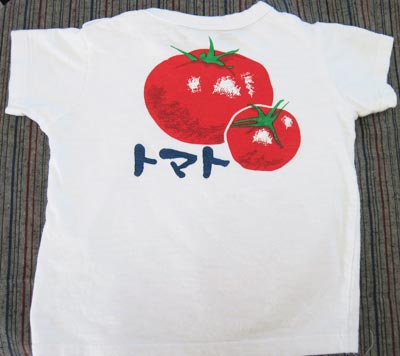
The name of the vegetable (or fruit?) in Japanese, and the pronunciation of the syllables that decorate this baby T-shirt.
Yesterday was the fourth Sunday in June, so the day of the local Japanese community's annual flea market. I didn't really need a baby T-shirt, but at $.25, the design was too adorable to resist. I'm hoping it will fit a neighbor's one-and-a-half year old, so I can take pictures of him wearing it as he toddles by. He is a fast one, but maybe I can manage to get a rear view—


Two labels sewn inside the collar—


Another item I couldn't manage to resist—

This truly is using your noggin!

There are always giveaway piles, too. I picked up some home-maker magazines—

"Heart and Hand" (above, left) is devoted to recipes and crafts. Here are directions for making gift envelopes from decorative papers—

I like the inexplicable prop here; this hand-made envelope will be just the thing for storing your Blue Eagle tickets!

More seriously, it's interesting how this real artifact can become a context-free prop in a Japanese magazine illustration. I can't find any background, but the image shows tickets printed "In full compliance"—
Globe [?] Ticket Company, Los Angeles
(According to teeny and partly blurred font in magazine image)
The L.A. event may have been held under of the auspices of the Federal Theatre Project, which promoted public performances throughout the country. The Library of Congress's FTP collection includes photos; posters for plays and other public performances are in the WPA poster collection. Though I've seen lots of archival images, I've never come across tickets that from one of these long-ago events.

It's history that is all but lost to popular knowledge. And a depressing, if unsurprising, thing: never try searching "NRA" without adding, Great Depression.

Saturday, December 24, 2011

Crafts For All Seasons

How about these, for last minute gift-making ideas?

From this publication—I have several copies, found on the shelves the library provides for magazine donation/recycling/local house cleaning. This one is the oldest (1967); the others are from the early '70s.

According to a collector, the magazine began as a family enterprise in 1935, with 16 newsprint pages of sewing and needlecraft patterns. By the late 1940s it had become successful enough to expand to a small magazine format. Bought by a larger company in 1990, the magazine folded six years later.

My '60s-'70s copies still are mostly newsprint; covers, plus a few interior illustrations and ads, are in color.

The magazine's long-time formula was a homey mix of recipes and needlework or other craft projects. Most of this went for the price of a subscription, or a single issue ($.25 to $.35 during this period), though some pages were devoted to sewing and other projects requiring readers to order patterns by mail.

Each month buyers got new patterns, like these good looks of the '70s—


Ads include lots of money-making schemes, both occupational and fund-raising.

A regular feature:

Not only could readers make $.25 to $1.00 a piece for these...
... but they also would earn $2 for a published submission (raised to $5 in the '70s).

Besides money-making opportunities, there were the usual women's magazine possibilities for self-improvement—even if companies and ads may have been a bit less slick than those in the pages of Good Housekeeping or McCall's


Although there were some brand-name products also sold in stores, most items were mail order only, from companies that didn't seem to come with a Workbasket Seal of Approval.

While they would not exactly get their designers into MOMA...
...the products were made by small manufacturers located throughout the US. Ads for their wares crowded the pages of what, according to the collector's site above, had grown from its start in 1935, when—
The depression was in full swing, and Clara Tillotson's husband Jack had lost his job. Mrs. Tillotson used her resources and began putting together knitting, crocheting, tatting and quilting instructions. It was a time when people didn't have the money for new things; if they needed something, they made it. She sold patterns through the mail under the guise Aunt Martha's WORKBASKET; Home and Needlecraft for Pleasure and Profit.

Saturday, May 22, 2010

1945 Magazine Catalog

A souvenir of the era when department stores sold everything, including books and magazines.

This catalog for 1945 subscriptions would have been published in 1944. The emphasis is on red-white-and-blue, and the continued state of war.

Uncle Sam and "Mrs. Uncle Sam" stand beneath a rendering of the cast-iron entrance to Louis Sullivan's Carson Pirie Scott building.

The story of Mrs. Uncle Sam is on the inside cover.
... She was only a baby when her folks build their first rude log cabin at Jamestown. She was in pigtails when Uncle Sam first began to notice her—that cruel winter at Plymouth. He was ready to pop the question the night Cousin Paul Revere rode so furiously down the road to Lexington...
It continues in this vein, from the couple marrying after Yorktown; "a framed copy of the Bill of Rights...the first picture hung on their walls."

There's the crossing the plains and heading off Indians; then on to the 1860s, when Mrs. Sam went "on the battlefield to nurse [Uncle Sam], and his wounded brothers of the South." Next,
She bought Liberty Bonds with their savings during the first World War. She managed wonderfully all through the depression.
Today, she stands in the front line with Uncle Sam—to defend what they built togehter. She knows he needs her now, as never, never before.
...
And Mrs. Uncle Sam faces this resolutely, serenely and free!

We salute you homemakers—mothers and women of America—for you are Mrs. Uncle Sam.
One magazine on offer:


The war would actually end in the summer of 1945, and Time was already pitching post-war life


War or peace, Time was willing as ever to take "news-words," and "boil them down and point them up and connect them together for you..."

Then, as now, considerately sparing readers the work of thinking for themselves.