

Showing posts with label Packaging. Show all posts
Showing posts with label Packaging. Show all posts
Tuesday, May 1, 2018

Friday, November 24, 2017


Tuesday, January 17, 2017
Tales From the Schmatta Trade (1)
As told on thrift shop sale day...
(from pinterest: a product of somewhat newer vintage)

The Vanity Fair brand still exists—as VF, which includes more recently purchased brands (Lee, Timberland). As company history would suggest, the organization went from specializing in ladies' unmentionables to encompassing what might be the other end of spectrum—products meant to convey an image of the rugged outdoors. By now, however, all the stuff likely comes from the same set of Chinese factories.
Marcus & Wiesen, Inc., is not mentioned in that history page, and was probably a sub-contractor for Vanity Fair.
The name does appear in Chain Store Age, Volume 17 (1941). In the section, Directory of Manufacturers (page 42, under "Garters, Ladies' & Children's"), Marcus & Wiesen is listed at 26th E. 14th St., New York.
An extensive and interesting history of 22-26 East 14th Street is found in the New York City Landmarks Preservation Commission's 2008 report (pdf). The building began as Baumann Brothers Furniture and Carpet Store, built 1880-1881.
At some point the company relocated from such valuable real estate as its original home, but continued in its industry for an undetermined period of time. The last reference I find is from 1995, per a note in this book, Unions and Workplace Reorganization (edited by Bruce Nissen).

A note that's sadly quaint in itself; just imagine, companies deigning to talk with unions. And, it turns out, 1995 was when the storied ILGWU last existed under that name.
 |
| Marcus & Wiesen, Inc Made in U.S.A. |
(from pinterest: a product of somewhat newer vintage)

The Vanity Fair brand still exists—as VF, which includes more recently purchased brands (Lee, Timberland). As company history would suggest, the organization went from specializing in ladies' unmentionables to encompassing what might be the other end of spectrum—products meant to convey an image of the rugged outdoors. By now, however, all the stuff likely comes from the same set of Chinese factories.
Marcus & Wiesen, Inc., is not mentioned in that history page, and was probably a sub-contractor for Vanity Fair.
The name does appear in Chain Store Age, Volume 17 (1941). In the section, Directory of Manufacturers (page 42, under "Garters, Ladies' & Children's"), Marcus & Wiesen is listed at 26th E. 14th St., New York.
 |
| Emilio Guerra |
One of the more prominent, prolific, and versatile New York firms in the late-nineteenth century, D. & J. Jardine executed designs for a wide variety of building types, including a number of notable cast-iron fronts, in contemporary styles. The wide cast-iron front facade of the Baumann Brothers store, manufactured by the West Side Architectural Iron Works, is one of the Jardines' and one of the city's most inventive, unusual, and ornamental. Built toward the end of the heyday of cast-iron fronts in New York and the flourishing creativity in that material, the Baumann Brothers store is also a signal achievement of Aesthetic Movement design.In 1884 Baumann Brothers occupied the entire building and advertised as, "the largest and most complete furnishing establishment in America." During the twentieth century—
For eight decades, the ground story contained 5-10-and-25-cent stores, beginning with the fourth Woolworth store in Manhattan (1900-28), acclaimed at its opening as "the largest ten-cent store in the world" and in 1910 the location of the chain's first lunchroom. This space was later a store for F. & W. Grand, H.L. Green, and McCrory. The upper stories were leased for over eight decades for show rooms and manufacturing by various firms related to the textile and sporting goods industries. This was the location of Rubens & Meyer, hosiery (1901-14); [Lewis Mark] Hornthal, [Joseph J.] Benjamin & [Simon R.] Riem, wholesale clothing manufacturers (c. 1902-23); Sohn, Oppenheimer & Co., fine trousers (1913-29); [Alex] Marcus & [Alex] Wiesner (later Wiesen), elastic specialties, garters, and girdles (1930-85)...Following ownership changes over the years, the lot was transferred
... in 1967 to the Marcus & Wiesen Realty Corp., whose principals were the long-term garter-making tenants in the building. The southern portion of the lot and the building were conveyed in 1902 to the James McCreery Realty Corp., which retained ownership until 1965, when they were acquired by the Marcus & Wiesen Realty Corp. The entire property was sold to Irving and Elliott Sutton in 1979. The building became a condominium in 1999. The upper stories (Lot 1101), acquired at that time by the New School University, are currently in use as an annex to the Parsons School of Design, while the ground story contains a drugstore and several small shops.Along the way, the "garter-making tenants" were involved in some legal drama, according to the 1940 Federal Supplement: Cases Argued and Determined in the District Courts of the United States and the Court of Claims, with Key Number Annotations, Volume 30 (Page xxix). The case in District Court of NY.: Marcus & Wiesen v. Universal Brassiere & Just-Rite Corset Co.
At some point the company relocated from such valuable real estate as its original home, but continued in its industry for an undetermined period of time. The last reference I find is from 1995, per a note in this book, Unions and Workplace Reorganization (edited by Bruce Nissen).

A note that's sadly quaint in itself; just imagine, companies deigning to talk with unions. And, it turns out, 1995 was when the storied ILGWU last existed under that name.
Sunday, August 16, 2015

Saturday, June 28, 2014
Uneasy ...
A second-hand Japanese product...

 ... with quite a tale to tell—
 After that build-up, it might seem the lemons should squeeze themselves.
But directions do appear...
 ... along with the usual extensive documentation and analysis of product features.
 Perhaps the theme should be more like, Easy there, Pal!
After all, you have to wonder what the utensils might get up to, as soon as your back is turned... seeing as how the manufacturer needs to assure you that your "living partner" has "a mild heart"—


But directions do appear...


After all, you have to wonder what the utensils might get up to, as soon as your back is turned... seeing as how the manufacturer needs to assure you that your "living partner" has "a mild heart"—


Saturday, June 21, 2014
Values
Sadly, the only local non-chain dollar store closed this spring. When the store was forced out of its original space last year, the owner moved to a much smaller space to stay in the neighborhood. Unfortunately, stock space and business decreased too much for him to make a go of the location.
It was a shame to see him and his family go. He was a good buyer, and I'll miss the possibility of surprise his stock offered.
I'll also miss having purchases put into bags from unknown supermarkets, located somewhere or other. These, like the stock, must have been bought in close-out lots.
Bags varied from trip to trip, and this one was the best.
 Such happy throwback people...

It was a shame to see him and his family go. He was a good buyer, and I'll miss the possibility of surprise his stock offered.
I'll also miss having purchases put into bags from unknown supermarkets, located somewhere or other. These, like the stock, must have been bought in close-out lots.
Bags varied from trip to trip, and this one was the best.


Saturday, April 12, 2014
Easter Parade
I have to admit that I spent several minutes transfixed in the aisle at Aldi with Easter promo stuff.
It was the German-made chocolate bunnies, chicks and lambs that had this hypnotic effect. In several different styles: all wacko, and all sugary stuff I don't need. In the end, I couldn't resist this group—


Sister J's immediate reaction: these must come from an East German factory, where the graphic style is unchanged since the 1950s.
I thought the googly-eyed faces are part of a more general German style. Sure enough, J later found this company site with similar stuff.

Although some of these products are a bit higher end ["Fairtrade"; "MinusL" lactose-free], there are others that definitely have appeared at the local Aldi.
Christmas for us; "First day of school" to Germans—

Sadly, there's also a sample of the New Year's fun and luck that we miss—


It was the German-made chocolate bunnies, chicks and lambs that had this hypnotic effect. In several different styles: all wacko, and all sugary stuff I don't need. In the end, I couldn't resist this group—

The outfits got me, complete with animal logos. And jolly Gumby-esque creature—

Sister J's immediate reaction: these must come from an East German factory, where the graphic style is unchanged since the 1950s.
I thought the googly-eyed faces are part of a more general German style. Sure enough, J later found this company site with similar stuff.

Although some of these products are a bit higher end ["Fairtrade"; "MinusL" lactose-free], there are others that definitely have appeared at the local Aldi.
Christmas for us; "First day of school" to Germans—
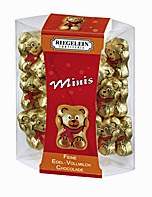
Sadly, there's also a sample of the New Year's fun and luck that we miss—


Saturday, February 23, 2013
Irresistable Objects...
... so tiny and impractical, yet so cute—
The second word, kurippu (クリップ), is simply Japanese pronunciation and written rendering of "clip."
Puchikko (ぷちっ子) isn't as easy. The basic meaning of 子 (ko) is "child," but it's also the most common ending of feminine names. (Here, the っ that comes before it doubles the "k" sound).
My dictionary shows puchi (プチ) as a Japanese version of the French word petit; used as in, puchi furo (petit fours), and, puchi buro (petit burgeois).
Despite the difference in writing puchi as プチ in katakana, normally used for words derived from other languages, vs. ぷち in hiragana, which usually renders syllables of Japanese meaning origin, it sure seems "puchi" should mean, "awfully small." In that case, puchikko kurippu might suggest something like, "junior peewee clip."
Though it also could be a proper name for the rabbit character, whose ears are adorably configured to echo the clip prongs.

As pervasive as miniaturization (and cuteness) are in Japan, this product may have been inspired by a particular one that was a big deal around the same time. Too bad I can't remember the name, but it was a miniaturized desk accessory set: a bento-inspired plastic box containing a stapler, scissors, plus a couple of other items, made in interlocking shapes to all fit inside. As I remember, it was designed by women office workers, which contributed to the novelty and amount of publicity.
That product was useable, as well as decorative, but these clips are not so practical: really too tiny to hold much of anything together.

 Even if "F. Cats" fit best on the surface space, it's mere shorthand for the true identity of these characters.
They are: Flying Cats, who had many amusing adventures on a mid-80s line of school supplies.
 |
| Japanese stationery store item, mid-1980s: Puchikko kurippu. |
Puchikko (ぷちっ子) isn't as easy. The basic meaning of 子 (ko) is "child," but it's also the most common ending of feminine names. (Here, the っ that comes before it doubles the "k" sound).
My dictionary shows puchi (プチ) as a Japanese version of the French word petit; used as in, puchi furo (petit fours), and, puchi buro (petit burgeois).
Despite the difference in writing puchi as プチ in katakana, normally used for words derived from other languages, vs. ぷち in hiragana, which usually renders syllables of Japanese meaning origin, it sure seems "puchi" should mean, "awfully small." In that case, puchikko kurippu might suggest something like, "junior peewee clip."
Though it also could be a proper name for the rabbit character, whose ears are adorably configured to echo the clip prongs.

As pervasive as miniaturization (and cuteness) are in Japan, this product may have been inspired by a particular one that was a big deal around the same time. Too bad I can't remember the name, but it was a miniaturized desk accessory set: a bento-inspired plastic box containing a stapler, scissors, plus a couple of other items, made in interlocking shapes to all fit inside. As I remember, it was designed by women office workers, which contributed to the novelty and amount of publicity.
That product was useable, as well as decorative, but these clips are not so practical: really too tiny to hold much of anything together.
Now, these are effective clips—


They are: Flying Cats, who had many amusing adventures on a mid-80s line of school supplies.
Thursday, April 26, 2012
World Tour, A Lá Dollar Store
Or, a tour of some random countries, at least, since shopping trips often turn up some items from places not known as "China." And if purchases are not akin to those of the Grand Tour, the price is right.
Can't say much for the highly artificial scent of the "mineral salts and seaweed" bars, but couldn't resist the wrapper (enlarged here)—

Uh, no; it would appear not—
 The offer of "Find Cash! In the bar if you're lucky" [according to my gracious host's translator] was past its expiration date, but winning a prize wouldn't have paid for the trip to claim it, as Rp 200,000 turns out to be not quite $22.
Sister J. has remarked on the odd paths by which merchandise comes all this way to sell for only $1. Complicated intrigue and money laundering were her suspicions...
Overactive imaginations aside, this is a store run by a nice family that's been in its nearby location for quite a few years, to the gratitude of the neighborhood. I've heard appreciative remarks from more than one customer, including the public school teacher who exclaimed, "If it wasn't for you, I couldn't afford to buy art supplies for my students!" But that's a whole 'nother story, about our brave new world of Tiffany's or Dollar Store...
I did want to find a juicer, and this Israeli-made plastic model does not smell toxic. Kitchen use requires removing the enjoyably retro packaging, but that's one thing cameras are for—
 It is a good design, with a handle that fits nicely in the hand—


And this is reminiscent of those happy, happy foodstuffs of 1950s cookbooks...

Can't say much for the highly artificial scent of the "mineral salts and seaweed" bars, but couldn't resist the wrapper (enlarged here)—

Uh, no; it would appear not—

Sister J. has remarked on the odd paths by which merchandise comes all this way to sell for only $1. Complicated intrigue and money laundering were her suspicions...
Overactive imaginations aside, this is a store run by a nice family that's been in its nearby location for quite a few years, to the gratitude of the neighborhood. I've heard appreciative remarks from more than one customer, including the public school teacher who exclaimed, "If it wasn't for you, I couldn't afford to buy art supplies for my students!" But that's a whole 'nother story, about our brave new world of Tiffany's or Dollar Store...
I did want to find a juicer, and this Israeli-made plastic model does not smell toxic. Kitchen use requires removing the enjoyably retro packaging, but that's one thing cameras are for—


And this is reminiscent of those happy, happy foodstuffs of 1950s cookbooks...

Thursday, March 29, 2012
Do the Japanese Have a Word For It?
Something along the lines of, "Cute, but obsolete technology"...
Even though cuteness is linked to the most of-the-moment fads and fashions, Japanese cartoon styles don't seem to change all that much over time. These mid-1980s store giveaways are inserts for audio cassette boxes—


Exotic places...

... But could The Message to your Heart emanate from anywhere as chic?


Even though cuteness is linked to the most of-the-moment fads and fashions, Japanese cartoon styles don't seem to change all that much over time. These mid-1980s store giveaways are inserts for audio cassette boxes—

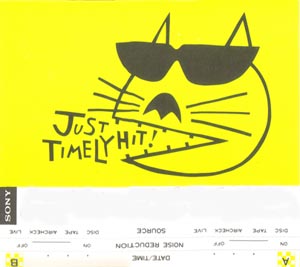

Exotic places...
... But could The Message to your Heart emanate from anywhere as chic?


Saturday, December 17, 2011
Hallelujah! Hallelujah!
The plastic wrapper from a kitchen item (cheesecloth straining bag) purchased in a Chinese grocery— Yes, this time of year and that translation could only make me think of this: some background and sound.
 Yes, this time of year and that translation could only make me think of this: some background and sound.
Monday, November 14, 2011
Art + Food Labels: Another Country Heard From
And, in marrying Famous Art to food packaging, that country will not be outdone.
With this Japanese product of the mid-1980s, the use of European masterpieces was as literal as could be: biscuits topped by molded chocolate reproductions of art works—

In good Japanese product education style, each work is explained for maximum consumer enlightenment. This applies not only to the merchandise, but also to the cultural artifacts represented—

Stats for each work of art are laid out: title, year created, dimensions of the piece, medium used, artist's name, and other identifying details—

These cookies were a common item, until disappearing at some point around '86 or '87. I missed them; they were tasty, along with providing entertaining and informative box reading.
They also provided odd associations at snack time.
After all, it was interesting that the subsidiary of a major U.S. brand would sell a product suggesting consumers munch on

Or take a naughty bite out of
With this Japanese product of the mid-1980s, the use of European masterpieces was as literal as could be: biscuits topped by molded chocolate reproductions of art works—

In good Japanese product education style, each work is explained for maximum consumer enlightenment. This applies not only to the merchandise, but also to the cultural artifacts represented—

Stats for each work of art are laid out: title, year created, dimensions of the piece, medium used, artist's name, and other identifying details—

These cookies were a common item, until disappearing at some point around '86 or '87. I missed them; they were tasty, along with providing entertaining and informative box reading.
They also provided odd associations at snack time.
After all, it was interesting that the subsidiary of a major U.S. brand would sell a product suggesting consumers munch on

Or take a naughty bite out of

For Export Only?
Well, there I was in Big Lots, home of mystery brands.
I was out of oil, the price was good...and, how could I resist this label?


Although something tells me their name isn't "Botticelli," there may be a fine Italian family behind this product, as the company's proclaimed "five generations of experience" tries to suggest.
It's perfectly good oil, and I've gone through half the bottle in a few months.
Luckily, that was before reading the taster reviews here...
But then, I am a sucker for this kind of labeling.
There was that can of tomatoes schlepped from Canada in the early 1990s, just for the label that's been part of my kitchen décor ever since:
 I don't know if this packaging is a tipoff that the products are for export. Italians certainly have a cultural legacy to advertise, but I never saw this kind of product labeling while traveling there. While playing up the glories of the Italian Renaissance to outsiders may be good marketing, perhaps Italians feel secure enough in knowing about this stuff that they don't need to be reminded by a "musterpiece" on an everyday product—
 In any case, I like the overly dramatic linkage of label with content.
From on high: the creation of man...
And, a nice can of peeled tomatoes!
I was out of oil, the price was good...and, how could I resist this label?


Although something tells me their name isn't "Botticelli," there may be a fine Italian family behind this product, as the company's proclaimed "five generations of experience" tries to suggest.
It's perfectly good oil, and I've gone through half the bottle in a few months.
Luckily, that was before reading the taster reviews here...
While a few tasters liked this "potent" oil, others said they detected "mushroom," "rotten walnuts," "a Band-Aid wrapped in a cherry blossom," and a quality that was "downright medicinal-Triaminic, anyone?" Several deemed it "overpowering" and "musky," with a "rank, off-flavor." "Tastes not like olives but like the armpits of olive laborers," shuddered one.I quote those for entertainment purposes only; I may have been lucky, but my batch tastes fine.
But then, I am a sucker for this kind of labeling.
There was that can of tomatoes schlepped from Canada in the early 1990s, just for the label that's been part of my kitchen décor ever since:
 I don't know if this packaging is a tipoff that the products are for export. Italians certainly have a cultural legacy to advertise, but I never saw this kind of product labeling while traveling there. While playing up the glories of the Italian Renaissance to outsiders may be good marketing, perhaps Italians feel secure enough in knowing about this stuff that they don't need to be reminded by a "musterpiece" on an everyday product—
 In any case, I like the overly dramatic linkage of label with content.
From on high: the creation of man...
And, a nice can of peeled tomatoes!
Sunday, August 28, 2011
Hello!

The quaint design has been in use for some time, as the wrapper is from only a few years ago.
I used to see this often in Asian groceries. I haven't thought to look for it lately, so I wonder if the manufacturer still uses the logo—what with everyone in Thailand no doubt on a cell.
I do like the retro design ... even if this is way too much like being at the office—

Subscribe to:
Posts (Atom)