Showing posts with label Children's Books. Show all posts

Wednesday, January 4, 2017

Speaking In Code

Now that we're told it's best we shut up about pre-election hacking communicate by courier, this will come in handy...
How to Write Codes and Send Secret Messages, Scholastic, 1966
Author John Peterson apparently had a background in illustration, but pictures here are done by the great Bernice Myers.


Lucky readers can learn the secrets, just by following the how-to's: of Space Codes, Hidden Words Code, Invisible Ink, and more...
Can you read it? The message is...


Where there's a will...

... But, on the other hand: "If you can't train your dog, maybe your friend can train his dog."


Sunday, April 10, 2016

Water All Around

Withdrawn school library book, found on the public library sales reject-overflow cart—
1959 (first ed.)
Science explained simply and entertainingly, with charming illustrations by Bernice Myers.


Sometimes the water vapor itself, high up in the air, freezes instead of condensing into water droplets.
The frozen water vapor falls.
We have snow

...water sometimes flows up!
This was part of a series by the same authors and illustrator (Electricity/Friction/Gravity/Light/Sounds... All Around). Fishink has samples of other books in the series. Like "Water," the rest of the series used B&W and two-tone illustrations. The link also has some wonderful, more colorful illustrations from other books, and those apparently are more typical of Myers' work. Elsewhere, Eric Sturdevant has illustrations from some French titles.

Fishink proprietor Craig adds—
I did get in touch with Bernice who told me that she was flattered to be featured on my blog. How great is that !! She also mentioned that the work you see above [All Around series], helped her to pass a test for a Ford Foundation Scholarship, where she learnt enough to go for a specially created college degree. Some 60 books later and she's still working !

That was in 2012; it seems she's still at work, though she doesn't have a web presence herself. Just fans posting stuff; according to this, she turned 90 last April. I do find that I recognize her son from his jazz writing.

She often collaborated with her husband, Lou Myers. He died at 90 in 2005, continuing to work until nearly the end. The Times' obit is fascinating in its details of Lou's life and career, apart from childrens' books.

The couple lived for years in Paris, and their collaboration is an intriguing one. A jacket image from Studevant's blog—

Childrens' books, 1959, and roles that were (to say the least) gendered... Although, if Mother was stuck in the kitchen while Father had the fun...

... Ms. Myers managed to slip in a hint about Mother's physical and emotional state...

Sunday, March 8, 2015

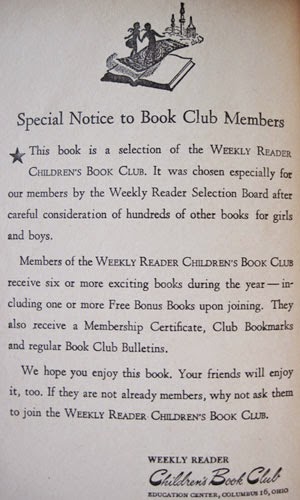
Reader's Leader

What caught my attention here was that this is a hardback, and I didn't realize the publisher had ever issued them.

I see that the company is older than I had realized. The look is cheap, and I would guess this came close to the end of hardback editions.

On the back cover—

This seal/logo appears inside, where it's more apparent that the children are not romping to church, but are riding a magic carpet...

The subject at hand—

From the author—

Getting a look at page one...
...I had assumed that Jimmy was beamed at the ballgame. But it happens on July 5, when a kid finds and throws an unexploded firecracker, and it hits Jimmy.

After his release from the hospital Jimmy will have new lessons to begin learning...
Jimmy goes off to guide-dog school, where he's also taught daily life skills. When he comes home with Leader, there will be trials and tribulations. To attend his previous school, Jimmy will be forced to leave Leader during the day. The dog will accompany Jimmy's return to his Boy Scout troop, but resentful Mike (the kid who threw the firecracker) is there, too. After Mike repeatedly teases Leader, the dog bites him and is quarantined. Ultimately, Jimmy and Mike will make peace, and Leader will be cleared to come home (instead of the other possible outcome Jimmy is told to prepare for).

As the conclusion draws near, plucky Jimmy has learned the many coping skills he will need in life. A Scout trip follows, during which Leader not only saves Mike from drowning, but guides a group of lost boys back to camp.

At their next meeting, the scoutmaster gives a speech to recap Jimmy's accomplishments, "reminding the patrol that in spite of his blindness Jimmy was going to public school, selling newspapers and making money at it, and now had kept up with the best of them on a camp-out with the troop." Suggesting Leader deserves "an honorary life-saving award," he hands Jimmy a piece of blue ribbon—
"Put this around the dog's neck and you can demonstrate how good you are at tying a butterfly bow."

Leader sat like a statue while Jimmy tied the ribbon and the boys again applauded.

"Sir!" Mike spoke up when the noise had subsided. "I move that we adopt Leader as our mascot and that we change our name to the "'Dog Star Patrol.'"
The Scouts cheer and pass the motion, then gather round to pet Leader. When the dog soon nudges him that it's time to go home, Jimmy lets the gang know
—"He'll make a swell mascot in his spare time, but he knows his main job is being four-legged eyes for me."

Then, moving toward the door, with a wide smile and a cheerful wave of his hand, Jimmy gave the command—"Forward!"
And now: a final word from our sponsor.


Friday, January 2, 2015

We Return You To Our Regular Programming

New Year's charming little girl was evidently young enough to be allowed the gift of "A whole New Year — for me!"...
Artist: M. Hauge
But that was it, for such tomboyish ways; elsewhere, Childcraft rhapsodizes on the theme of housewives in training.
Artist: Meg Wohlberg

Thursday, January 1, 2015

Saturday, September 20, 2014

Divided Attention

Childcraft (v 2): Storytelling and Other Poems
1949 - Field Enterprises, Chicago
It seems this volume first appeared in 1923, as The Child's Treasury. The original publisher, W.F. Quarrie & Company, issued several editions into the 1930s; editions from 1939 to 1947 were published by the Quarrie Corporation.

Fields Enterprises (headed by an heir to Marshall Field) had moved into publishing by buying The Chicago Sun in 1944. From 1945 to 1978 the company owned the World Book encyclopedia. It seems the Childcraft series also was marketed by encyclopedia salesmen.

Other titles in series.

Endpapers—
The text has at least one illustration for page, with a single artist illustrating a 2-page spread. As a number of different artists are represented, the book is interesting for variations in period styles aimed at children.


Text is grouped in three sections: "Poems for Everyday," "Humorous Poems," "Storytelling Poems and Ballads."

Near the end is this colorful spread—

Patriotism here—

Followed by some broadening of the sales market—

I'll have to get to more illustrations in future, but another item of interest for now is an item left in the book. It would seem that around the 1980s, this copy was handed down to a child with more up-to-date daydreams than those the Fields Co. promoted—
Page from a tear-out sticker book (to scale)

Saturday, July 19, 2014

Problem Solved (In Under 100 Pages)

Young Adult fiction, 1974—
Full of '70s problems, for this California family. Parents' divorce, father's remarriage and suicide are the background. The current problem: 11-year old Chloris can't accept the loss of her father, and chooses to believe in a rosy past unlike the family's real history. And she's mad at her mother, who not only dates men as the novel opens, but has—a mere 59 pages later—married a widowed Mexican artist.

The new step-father: "Fidel Mancha"—as in Man of La ...

Faithful, indeed: Fidel's quest will be not against windmills, but to break through to Chloris, and end her increasingly dangerous behavior.

As described by the narrator, 8-year old sister Jenny, Fidel is a man of infinite patience, folk wisdom, and—
He is the happiest man I ever met. He is always laughing. When he isn't laughing, he sings or whistles.
Quite the catch—
Mom walked smack into the gallery that was exhibiting his paintings and sculpture pieces. She liked everything she saw, she said. Mr. Mancha was there, too, as most of the artists are at opening nights of their exhibitions. They got to talking to each other about this and that and discovered they had a lot in common. According to Mom, she didn't think about him being Mexican, one way or the other. All she saw was a very talented, big-hearted, good-natured human being. She found out he was a widower, and he found out she was a divorcee, and that was the beginning of everything.
On the other hand, to make him a bit less than super-human, "he has a big belly that swells out over his silver belt buckle."(Unless the belly and silver meant as details making him an extra-jolly Mexican ...)

Jenny's openness to Fidel  is used to introduce issues other than step-parenting—
Mr. Mancha is very easy to talk to and one day I asked him how come there were so few Chicanos at school, and what did they do to get out of it. Mr. Mancha explained that most black and browns were poor and couldn't get good jobs. That was why they couldn't afford to live in good neighborhoods like ours and go to our good school.

"This is a very good country," he said, "but some people are not so lucky. To be born the wrong color is a big mistake."

"But that's not fair," I said. "They can't help it."

Mr. Mancha smiled.
...

"So, how come?"

"Don't forget the Indians," Mr. Mancha said. "I think maybe they are even worse off."

"That's different," I said. "Indians used to scalp people. They attacked our wagon trains. They scalped all the helpless women and children."

Mr. Mancha looked puzzled. "Where did you hear that?"

"I saw it myself on TV"...

Mr. Mancha nodded and pursed his lips and didn't say anything. He didn't seem convinced. Maybe he's so busy painting pictures that he never gets to watch TV and you can miss a lot that way. I've probably seen over a hundred Indian massacres already and I'm only eight years old.
Mother and daughters soon move to Fidel's place, so he can be near his studio. The house (of course) is charming and artistic, in the natural surroundings of a peaceful canyon. The new setting lets Fidel school the girls on California history—
"All this land you are sitting on now... was once owned by Mexicanos. From here to the sea. Up north past Malibu and Santa Barbara. And Orange County, too—Yorba Linda, where our President was born—all California was Mexicano. They were the real Californios."
When Jenny asks how come, Fidel elucidates for a page and a half: missions and ranchos, land grants and treaties. Choris ostentatiously goes to her room, but Jenny wants to stay and hear the end.
"That's the whole story, little one. From now on, when you hear of some poor chicano complaining about how he is being treated, you will understand why. There was a time when he was somebody in this country."

I stood facing him, "I don't have anything against the chicanos, Fidel. And remember, I didn't take their land away from them. I'm only eight years old."

Fidels's laughter followed me all the way upstairs.
Well, it's really not a bad treatment for young readers, even if Platt can lay things on thickly, between the lessons and the dialog he gives his 8-year old.

Fidel's sense of justice also leaves him unimpressed by money. He makes art that interests him, selling if he chooses. When he buys Choris gifts he knows she's longed for, the gifts get "lost," or turn up damaged beyond use. When Jenny tells him he's wasting his good money, he laughs that money isn't important, it's what a person feels inside that counts. Jenny's reaction—
I looked up at Fidel, kind of disgusted. Had he had all those hundred thousand acres given to the original Don Bernardo Yorba during the Mexican reign, he would have given them all away if he felt like it.
Yup:  Jenny's narration does tend to be on the overly precocious and omniscient side. Though when the sisters speak with each other, Platt inserts slang—both period ("Right on!"), and—well—odd (they constantly exclaim, "Gy!")

I assumed "gy" was meant to be "gee," in a guise somehow more '70s What's Happening Now (a bit like the spelling, "phat," decades later). But Platt has one of the mother's pre-page 59 suitors ask the girls what's that word they keep using—
Mom answered for me. "The kids use it nowadays the way we used "Gee,' 'gosh' or 'golly.' They shortened it to Gy, pronounced Guy."
The laboriousness of this gives me the feeling that "Gy" was not exactly on everyone's lips. Perhaps the author was trying to invent Valley Girl speak, a few years ahead of its time?

Big belly aside, Fidel's character verges on romance novel wish-fulfillment; after all, what unattached gal wouldn't be attracted to such a wise, kind, teddy bear of a guy? And what hurting step-child wouldn't eventually warm to him? Never mind Chloris' attempt to burn down his studio; by the end, Fidel's sensitivity to her feelings, as expressed in his art, will reach her. Then she can stop being, in Jenny's words, "the biggest creep of all." All achieved from Fidel's introduction at page 59, to the conclusion at page 156.

Followed by these ads: more YA titles and authors I've never heard of.


The second two seem pretty much forgotten. But Donovan's book was reissued in 2010, and is considered the first YA general reader fiction to present a same-sex relationship between protagonists.

But I do remember this author and title—something for the 1970s adult reader—

Friday, May 16, 2014

Family Album

Judged by its cover, this library sale leftover looked more than a little bizarre—
"Grub," according to Goodall's introduction, was simply the family's nickname for son Hugo Eric Louis van Lawick, who spent extended periods of infancy and early childhood accompanying his parents on research trips.

Or, as the pictures and words have it—
There was a time when chimps came first in their lives...

but then things changed.
Grub, says Goodall
... had learned to imitate the roar of a lion, the whooping call of a hyena, the strange high-pitched bark of a zebra, and the grunting and lowing of a wildebeeste long before he could speak a single word of human language.

...

By the time Grub was two he could recognize and identify most of the different sorts of wild animals we encountered around camp or on our drives, just as a city child may pick out different makes of cars he sees in the streets. Grub stands no more danger of being attacked by a wild animal than a city child of being knocked over by a car, but from dawn to dusk our son is never out of the sight of some responsible person.
With pictures mostly by the photographer father, this originally was intended for grandparents and other family, not for publication, says Goodall.
But because so many people enjoyed it we decided that the pictorial account of a baby's life, in surroundings quite out of the ordinary to most people, might be appealing to other children and perhaps to their parents as well.
The result is a weirdly arresting mix: pictures from a childhood lived exceptionally close to a dramatic natural world—
Accompanied by the cutesiest of captions.
I made sure I didn't get left behind...

when Daddy and Mummy packed up to drive 600 miles to the shores of Lake Tanganyika

where the chimps are.
Mummy and Daddy built a whole, huge, strong, well-provisioned cage...
for ME!
In the next year's return to the field—
One morning I asked Mummy to help me study an elephant. But she wouldn't go close enough,
so I decided to study zebra on my own.

When I had finished I rushed back to tell Mummy about them.

The next day we moved to the Serengeti and I was able to get my first close look at a giraffe. Unfortunately it galloped away when Mummy ran after me.

Soon after this Daddy employed two nannies...
they were HUGE fun!

I always helped to collect firewood.


After reassuring readers about adult supervision, the book closes with Grub's kindergarten career ("I attended the local school and enjoyed outdoor sports the most")...
But I kept up O.K. with the academic side, too.

The End...
I've grown up a lot this year. I've learned to be ready for anything.
Now I'm all set for my next safari.