

Showing posts with label Seasons/Holidays. Show all posts
Showing posts with label Seasons/Holidays. Show all posts
Saturday, April 20, 2019

Thursday, January 1, 2015

Thursday, December 25, 2014
Putting The"X" in Xmas
Japanese Christmas card, 1985—
 Opening it reveals a popup scene: the priest, a sugary "traditional Japanese Christmas cake"...
 ... Surprise!
 No, that's not Who it would seem; the cartoon represents this guy. This was during his early career, as TV's popular "Beat Takeshi"—
"ダメ!" ["Damé!": bad], while holding his hands in an "X"(a Japanese signal for, "No!")
Well, Christianity is exotic to most Japanese, so related trappings serve well as comic props. All in good fun... Though I have always marvelled at the US corporate connection to Sanrio's card creation...


The targets of his jokes were often the socially vulnerable, including the elderly, the handicapped, the poor, children, women, the ugly and the stupid. Complaints to the broadcaster led to censorship of some of Kitano's jokes and the editing of offensive dialogue. Kitano confirmed in a video interview that he was forbidden to access the NHK studios for five years for having exposed his body during a show when it was totally forbidden.The explanation I got for this card is that the cartoon portrays a recurring bit on the Takeshi show. When a character does something naughty, the star materializes on a cross, hollering,
"ダメ!" ["Damé!": bad], while holding his hands in an "X"(a Japanese signal for, "No!")
Well, Christianity is exotic to most Japanese, so related trappings serve well as comic props. All in good fun... Though I have always marvelled at the US corporate connection to Sanrio's card creation...

Saturday, April 12, 2014
Easter Parade
I have to admit that I spent several minutes transfixed in the aisle at Aldi with Easter promo stuff.
It was the German-made chocolate bunnies, chicks and lambs that had this hypnotic effect. In several different styles: all wacko, and all sugary stuff I don't need. In the end, I couldn't resist this group—


Sister J's immediate reaction: these must come from an East German factory, where the graphic style is unchanged since the 1950s.
I thought the googly-eyed faces are part of a more general German style. Sure enough, J later found this company site with similar stuff.

Although some of these products are a bit higher end ["Fairtrade"; "MinusL" lactose-free], there are others that definitely have appeared at the local Aldi.
Christmas for us; "First day of school" to Germans—

Sadly, there's also a sample of the New Year's fun and luck that we miss—


It was the German-made chocolate bunnies, chicks and lambs that had this hypnotic effect. In several different styles: all wacko, and all sugary stuff I don't need. In the end, I couldn't resist this group—

The outfits got me, complete with animal logos. And jolly Gumby-esque creature—

Sister J's immediate reaction: these must come from an East German factory, where the graphic style is unchanged since the 1950s.
I thought the googly-eyed faces are part of a more general German style. Sure enough, J later found this company site with similar stuff.

Although some of these products are a bit higher end ["Fairtrade"; "MinusL" lactose-free], there are others that definitely have appeared at the local Aldi.
Christmas for us; "First day of school" to Germans—
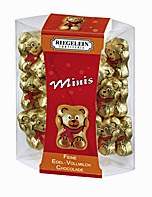
Sadly, there's also a sample of the New Year's fun and luck that we miss—


Wednesday, May 1, 2013
Workers of the World
When did this bit of re-branding take hold? Before today, I never knew the International Workers' Day ignored in the US had become "College Decision Day."
I have a feeling that for much of a generation, it will turn out to be "National False Expectations Day," considering student debt, a "jobless economy," and the like.
Elsewhere...
No idea of the title, author, or publication date of this item. Front matter is exclusively in the same language as the cover. Maybe it's Malayalam, for Kerala?
 The flag seems to be the banner of the Communist Party of India(Marxist).
Not to be confused with this Communist Party of India.
I have a feeling that for much of a generation, it will turn out to be "National False Expectations Day," considering student debt, a "jobless economy," and the like.
Elsewhere...
No idea of the title, author, or publication date of this item. Front matter is exclusively in the same language as the cover. Maybe it's Malayalam, for Kerala?

Not to be confused with this Communist Party of India.
Sunday, January 1, 2012
Bonne Année
 Early 20th century French card, actual size.
 Partly tinted photo, with embossed New Year's greeting.
Saturday, December 24, 2011
Crafts For All Seasons
How about these, for last minute gift-making ideas?

From this publication— I have several copies, found on the shelves the library provides for magazine donation/recycling/local house cleaning. This one is the oldest (1967); the others are from the early '70s.
According to a collector, the magazine began as a family enterprise in 1935, with 16 newsprint pages of sewing and needlecraft patterns. By the late 1940s it had become successful enough to expand to a small magazine format. Bought by a larger company in 1990, the magazine folded six years later.
My '60s-'70s copies still are mostly newsprint; covers, plus a few interior illustrations and ads, are in color.
The magazine's long-time formula was a homey mix of recipes and needlework or other craft projects. Most of this went for the price of a subscription, or a single issue ($.25 to $.35 during this period), though some pages were devoted to sewing and other projects requiring readers to order patterns by mail.
Each month buyers got new patterns, like these good looks of the '70s—


Ads include lots of money-making schemes, both occupational and fund-raising.

A regular feature:

Not only could readers make $.25 to $1.00 a piece for these...
 ... but they also would earn $2 for a published submission (raised to $5 in the '70s).
Besides money-making opportunities, there were the usual women's magazine possibilities for self-improvement—even if companies and ads may have been a bit less slick than those in the pages of Good Housekeeping or McCall's—


Although there were some brand-name products also sold in stores, most items were mail order only, from companies that didn't seem to come with a Workbasket Seal of Approval.

While they would not exactly get their designers into MOMA...
...the products were made by small manufacturers located throughout the US. Ads for their wares crowded the pages of what, according to the collector's site above, had grown from its start in 1935, when—

From this publication—
 I have several copies, found on the shelves the library provides for magazine donation/recycling/local house cleaning. This one is the oldest (1967); the others are from the early '70s.
According to a collector, the magazine began as a family enterprise in 1935, with 16 newsprint pages of sewing and needlecraft patterns. By the late 1940s it had become successful enough to expand to a small magazine format. Bought by a larger company in 1990, the magazine folded six years later.
My '60s-'70s copies still are mostly newsprint; covers, plus a few interior illustrations and ads, are in color.
The magazine's long-time formula was a homey mix of recipes and needlework or other craft projects. Most of this went for the price of a subscription, or a single issue ($.25 to $.35 during this period), though some pages were devoted to sewing and other projects requiring readers to order patterns by mail.
Each month buyers got new patterns, like these good looks of the '70s—


Ads include lots of money-making schemes, both occupational and fund-raising.

A regular feature:

Not only could readers make $.25 to $1.00 a piece for these...
 ... but they also would earn $2 for a published submission (raised to $5 in the '70s).
Besides money-making opportunities, there were the usual women's magazine possibilities for self-improvement—even if companies and ads may have been a bit less slick than those in the pages of Good Housekeeping or McCall's—


Although there were some brand-name products also sold in stores, most items were mail order only, from companies that didn't seem to come with a Workbasket Seal of Approval.


While they would not exactly get their designers into MOMA...

...the products were made by small manufacturers located throughout the US. Ads for their wares crowded the pages of what, according to the collector's site above, had grown from its start in 1935, when—
The depression was in full swing, and Clara Tillotson's husband Jack had lost his job. Mrs. Tillotson used her resources and began putting together knitting, crocheting, tatting and quilting instructions. It was a time when people didn't have the money for new things; if they needed something, they made it. She sold patterns through the mail under the guise Aunt Martha's WORKBASKET; Home and Needlecraft for Pleasure and Profit.
Saturday, December 17, 2011
Hallelujah! Hallelujah!
The plastic wrapper from a kitchen item (cheesecloth straining bag) purchased in a Chinese grocery— Yes, this time of year and that translation could only make me think of this: some background and sound.
 Yes, this time of year and that translation could only make me think of this: some background and sound.
Friday, October 28, 2011
Autumn Leaves
Seasonal notes, from library sale packets of children's book illustrations. (Previous example.)
This was first published in 1948: Now It's Fall, by Lois Lenski.

It's part of her "Seasons Series," described in this bibliography:

 There's no sign of when this particular printing was. But the look is very different from the "gently recolored" pages of the latest (2000) edition, as a few preview pages demonstrate.
And cut from an unknown book—

Other side—
 The clothes might belong to almost any time from the 1920s-40s.
But, fashion was on a somewhat longer cycle then.
This was first published in 1948: Now It's Fall, by Lois Lenski.

It's part of her "Seasons Series," described in this bibliography:
Using a rhyming text and simplified illustrations, Lenski depicts the change of seasons as it affects children: windy days, gardening, playing outside, and celebrating holidays such as Halloween, Thanksgiving, and Christmas... All the books use a child-size format.


 There's no sign of when this particular printing was. But the look is very different from the "gently recolored" pages of the latest (2000) edition, as a few preview pages demonstrate.
And cut from an unknown book—

Other side—
 The clothes might belong to almost any time from the 1920s-40s.
But, fashion was on a somewhat longer cycle then.
Friday, December 24, 2010
Yuletide Entertainments

Title page:
YULETIDE ENTERTAINMENTS
CHRISTMAS RECITATIONS, MONOLOGUES, DRILLS, TABLEAUX, MOTION SONGS, EXERCISES, DIALOGUES, AND PLAYS
SUITABLE FOR ALL AGES
BY ELLEN M. WILLARD
CHICAGO, T.S. DENISON & COMPANY, 1910
 (Back cover)
The front matter includes this assurance:
The songs in this book are to be sung to old airs that are presumably familiar to everyone. If any of them should prove unfamiliar, however, the music will be found in Denison's "Songs Worth While," one of the best arranged and most carefully edited collections of old favorites ever published. This book is beautifully printed, in non-glossy paper, measuring 10¾ by 7 inches, and is well bound in a stout paper cover done in colors. It may he obtained from the publisher for the price of $1.00, postpaid.
 (Ad page, at back of the book).
Then we have these words of guidance:
INTRODUCTORYRather exacting entertainment...
It becomes more and more a part of Christmas gayety to present the legends, or the spirit of it, to the eye as well as the mind.
For this purpose the following pages have been prepared in play and pantomime, songs and marches, drills and recitations. While the needs of adults have not been forgotten, those of the children have been most largely remembered, since Christmas is pre-eminently the children's festival.
A word to those who take charge of such affairs may not be amiss.
Precision of movement is the keynote of success for everythinng of this kind. This does not mean stiffness, but it does mean exactitude and certainty. Uncertain gestures in speaking; scattered attack and close in singing; hesitation in acting; and, more than all, careless motions and marching in the drills (corners not formed squarely, motions only half in unison, etc.)—all these are fatal to that success which makes such entertainments entertaining.
Here, as everywhere else, "What is worth doing at all, is worth doing well."
There are no real illustrations, just a few diagrams, in this paperbound book, "Price, 40 cents." Those figures include a frame and screen arrangement for use as a stage, and diagrams of the movements to be made for specific drills and dances.
The latter two look pretty complicated. "Dance of the Holly and the Mistletoe; For Eight Young Girls or the Number May Be Doubled," has six illustrative figures and seventeen steps in the directions.
The period skits include the usual moral tales about learning the true meaning of Christmas.
There are the usual ethnic stereotypes, such as, "The Pickanny's Christmas."
"Santa Claus in Many Lands" features actors who each dress as a "country," with countries including "Hindustan" and "Esquimaux." "China," has lines in excruciating pidgin to express how much "me likee Melican Santa." Though the dialogue sort of suggests that even countries that don't celebrate Christmas have their points, and at the end, Santa arrives to say he loves all the children.
If this all does not provide adequate entertainment, the publisher also offers:

Friday, January 1, 2010
Omedeto Gozaimasu!
 It's New Year's Day, in a 1958 Japanese "twelve months of the year" children's reader.
 More literally, the title is something like, "Society [or, public life] through the twelve months." The book actually begins in April, with the start of the school year, and covers the milestones of the year for children and families.
The full-color, detailed plate above is one of only three, in this book of mixed illustration styles.
Covers:


Endpapers:

The text is illustrated in a spare, woodcut-like style, in limited colors. So the other New Year's activities include traditional games (and a giant pot of mochi):


This is just over a dozen years since the war's end, and most Japanese families are still fairly poor. The book looks like it was produced cheaply, but the couple of cheerful full-color plates do seem to signal that life is getting better.

Subscribe to:
Posts (Atom)