Showing posts with label Education. Show all posts

Wednesday, January 4, 2017

Speaking In Code

Now that we're told it's best we shut up about pre-election hacking communicate by courier, this will come in handy...
How to Write Codes and Send Secret Messages, Scholastic, 1966
Author John Peterson apparently had a background in illustration, but pictures here are done by the great Bernice Myers.


Lucky readers can learn the secrets, just by following the how-to's: of Space Codes, Hidden Words Code, Invisible Ink, and more...
Can you read it? The message is...


Where there's a will...

... But, on the other hand: "If you can't train your dog, maybe your friend can train his dog."


Thursday, September 8, 2016

Creating with Printing Materials

1969 translation of a 1968 German teaching guide. I find the credits confusingly Germanic, but here goes. Author is Lothar Kampmann, acknowledging work by students of the Ruhr Advanced Teachers' Training College, Dortmund Section. That acknowledgement apparently applies to a section illustrating techniques, some used in succession to create complex prints. The book also credits illustrations from other printed sources, along with a school in Trantenroth, Bochum (also the Ruhr), the Kothe-Marxmeier School (the source of at least some of the student work reproduced, it would seem).

When introducing a variety of techniques, authorial outlook is sometimes philosophical.
It starts with fingermarks
We see our children's first printing achievements on wallpaper and windowpanes, in magazines and books: their fingermarks. They are greasy or black with dirt Sometimes jam makes them coloured. They may be annoying to the housewife, but technically they are genuine poducts of printing. The young artist merely has to be guided on to the right lines.

Dirt and jam make way to colour. The little cups of the poster-paint box are ideal as the first inking pads. Since the tip of the thumb and the fingertips are of different sizes, we already have various sizes of block available for finger painting.
This is not by any means a technique only for infants' schools. Masters as eminent as Pablo Picasso have repeatedly made use of fingerprinting in lithography.

...

The whole hand, too is a suitable block. The print of a single hand can be extended with a print of the edge of the hand, the single whole fingers, or the fingertips. Or 'many hands' are used for printing.
Such handprints are known from the very early days of man. Neanderthal and Lascaux man used earth-coloured handprints in their cave paintings. One can rightly regard the fingerprint as the beginning of printing both for the individual and the human race.
In the sample work by students, ages range from nine to the teens. Some of this looks pretty sophisticated to me.
'Two Figures' (girl, 16). Paper print of patterns cut out of cartridge paper. Water colours.
Mostly, students observed their surroundings.
'In Port' (boy, 11). Grey-tone lino-cut.
'View of the Town through Scaffolding' (boy, 14). A lino-cut in which shape and white-line printing are combined.
'Industrial Landscape' (boy, 15). Two-colour roller print, brown and black block-printing ink.
'My Daddy is a Miner' (girl, 9). Print-through from a glass plate. All accidental features are reproduced.
Images suggests the region's heavy industry was still very evident in the 1960s. Now, notes wiki, Dortmund
...is known as Westphalia's "green metropolis". Nearly half the municipal territory consists of waterways, woodland, agriculture and green spaces with spacious parks... This stands in a stark contrast with nearly a hundred years of extensive coal mining and steel milling in the past.
Gritty though the area may have been at the time of this publication, that didn't stop the author from finding this merited a stern finger wag.
'Bicycles Outside the Playground' (boy, 14). Print-through monotype.
This is not how they should be left, blocking the entrance.
Industrial landscapes may have changed, but this 12-year old girl's lino-cut observes a scene that remains familiar (and pretty much universal).
'After a day's work, only Mummy has to carry on'

Sunday, April 10, 2016

Water All Around

Withdrawn school library book, found on the public library sales reject-overflow cart—
1959 (first ed.)
Science explained simply and entertainingly, with charming illustrations by Bernice Myers.


Sometimes the water vapor itself, high up in the air, freezes instead of condensing into water droplets.
The frozen water vapor falls.
We have snow

...water sometimes flows up!
This was part of a series by the same authors and illustrator (Electricity/Friction/Gravity/Light/Sounds... All Around). Fishink has samples of other books in the series. Like "Water," the rest of the series used B&W and two-tone illustrations. The link also has some wonderful, more colorful illustrations from other books, and those apparently are more typical of Myers' work. Elsewhere, Eric Sturdevant has illustrations from some French titles.

Fishink proprietor Craig adds—
I did get in touch with Bernice who told me that she was flattered to be featured on my blog. How great is that !! She also mentioned that the work you see above [All Around series], helped her to pass a test for a Ford Foundation Scholarship, where she learnt enough to go for a specially created college degree. Some 60 books later and she's still working !

That was in 2012; it seems she's still at work, though she doesn't have a web presence herself. Just fans posting stuff; according to this, she turned 90 last April. I do find that I recognize her son from his jazz writing.

She often collaborated with her husband, Lou Myers. He died at 90 in 2005, continuing to work until nearly the end. The Times' obit is fascinating in its details of Lou's life and career, apart from childrens' books.

The couple lived for years in Paris, and their collaboration is an intriguing one. A jacket image from Studevant's blog—

Childrens' books, 1959, and roles that were (to say the least) gendered... Although, if Mother was stuck in the kitchen while Father had the fun...

... Ms. Myers managed to slip in a hint about Mother's physical and emotional state...

Saturday, June 20, 2015

Parlez-vous?

Among the free books on the shelf this year, a 1949 textbook.
Authors:
Sadly, water damage has warped the book and its classic end papers. In front, La France
The map highlights each province's sights and production agricole
In back—
Illustrations include many photos, with captions often adding the author's deux centimes worth.

Fishermen along the Seine don't have much hope of catching fish, but they enjoy the rest and the scenery.

Louis XVI in full splendor. A little less splendor might have saved his neck.
Author-illustrator Huebener apparently took the photos and wrote the captions. Their humor is of a piece with the cartoons he clearly relished drawing to illustrate lessons.
In this textbook, a jolly time seems usually to have been had.

Les élèves quittent l'école.
Something seemed familiar about this author's credentials and tone. Sure, the silly jokes reminded me of favorite teachers who took a similar approach; decades later, I still remember material via corny jokes cracked by those clever teachers. There was something else I couldn't quite put my finger on, not until starting to re-read Kate Simon's memoir, A Wider World. In the 1920s Simon had defied her immigrant father to attend a New York high school. Writing sixty years later, Simon found that,  English and music aside, she had no memory of most classes and teachers. Two German teachers were exceptions, and one of them was
... Dr. Huebner, who became one of the heads of language studies in the city's schools later on... [He] was beautiful, as precisely featured as a Gothic carving, but unlike those dour saints and knights, he smiled a lot, teaching us a good deal of German by way of songs and simpleminded jokes. So we sang and laughed and earned high Regents' Exam scores for Dr. Huebner.
The French textbook gives a good idea of that pedagogical approach. Even so, at least one student remained unimpressed by the good doctor's efforts.

Sunday, January 17, 2010

How To Have Fun And Learn

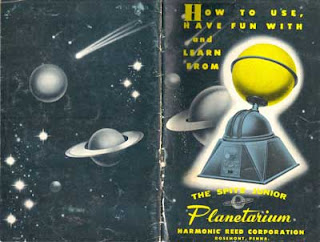
Cover, 1954 booklet by Armand N. Spitz

The author's name was not familiar to me, but I have learned that it's well-known in the planetarium world.

A non-scientist (who also didn't finish college), Mr. Spitz became an innovator in planetarium design during the 1940s. There's a bio here, and a long article here. And full-scale planetariums are still produced by Spitz, Inc.

From the '54 booklet, printed in Rosemont, Penna.—
FOREWARD
(To the adult or parent)

By the designers and producers of this Planetarium

There are many books written for children which can be and have been read and enjoyed by adults; seldom has the reverse been true. It was with this thought in mind that the author set about writing this book. The subject is not intended for any single person or group of persons. Its language is universal, but we feel that is it especially directed to our children, so that they can learn and appreciate all the wonders of the universe which so many of us have neglected and forgotten in the daily hustle and bustle of life.

...

Armand Spitz long dreamed of a small planetarium which could be placed in every home for the education and enjoyment of both adult and child, but with the problems of developing the large units he could not find the time, nor were his scientific contacts the type which could lead to national distribution through the major toy houses, chain and department stores. It was here that Harmonic Reed Corporation moved into the picture and began working out details of design and production. After many, many months of painstaking development and engineering a unit was designed which would lend itself to low-priced production. The result of this research is the "Spitz Junior Planetarium" which we hope will provide you, your friends and family many hours of real enjoyment.

HARMONIC REED CORPORATION
Manufacturers of Harmotone Musical Toys
As Spitz lived and worked in the Philadelphia area, his ideas must have come to the attention of this particular company. There is something touching in the enthusiasm and educational aims for this product—after all, this was before the 1957 Sputnik launch, and American concern over competing in a space race.

The booklet is a basic introduction to the stars and how to view and identify them. It encouraged kids to practice using the Spitz Junior so they could invite their friends over to see the show.

First step was to remember:
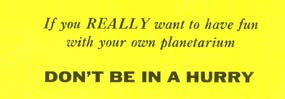
The user needed to read a few pages about the nature of stars. Next, orient himself to the planetarium ["When you sit in front of your planetarium...you are facing North, your back is to the South, the East is on your right...]

Then set the planetarium's axis for the user's latitude:
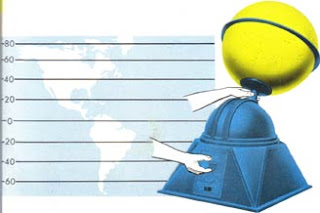

The booklet goes over stars seen north and south, during each season of the year.

Near the end:


One of the interesting things about your planetarium is that it can be used as a space machine, carrying you in an instant to other parts of the world, where you can see the stars in a different way.
Followed by directions for adjusting the planetarium's axis to change latitudes and travel the globe.

Further suggestions:

DON'T TRY TO SHOW TOO MUCH AT ONE TIME

VISIT PLANETARIUMS WHENEVER YOU CAN

Final suggestion:

...so go outdoors whenever you can, and see how easy it is to find the stars in the real sky after having learned them with the help of your own planetarium. Each night you'll learn some more things, until you'll feel at home whenever you look at the sky, from any part of the world. That's when you'll really understand how wonderful it is to recognize these stars which are so universal and ever-lasting.
Followed by a word from the sponsor:

Ah, the golden age of American small manufacturing.

Was it also the heyday of enthusiasm over pure science?

Why do I have the feeling that today, some similar (if higher-tech) toy would be marketed as: "your child needs this, to get into an elite school and make big money..."